Rhinoplasty Surgeons in Turkey: A Dedicated Specialist Team Built Around Your Nose
Our Istanbul rhinoplasty surgeons combine 10,000+ noses of experience, Piezo ultrasonic precision, and a dual-attending safety model — delivering Beverly-Hills-grade results to U.S. patients at a fraction of the cost.
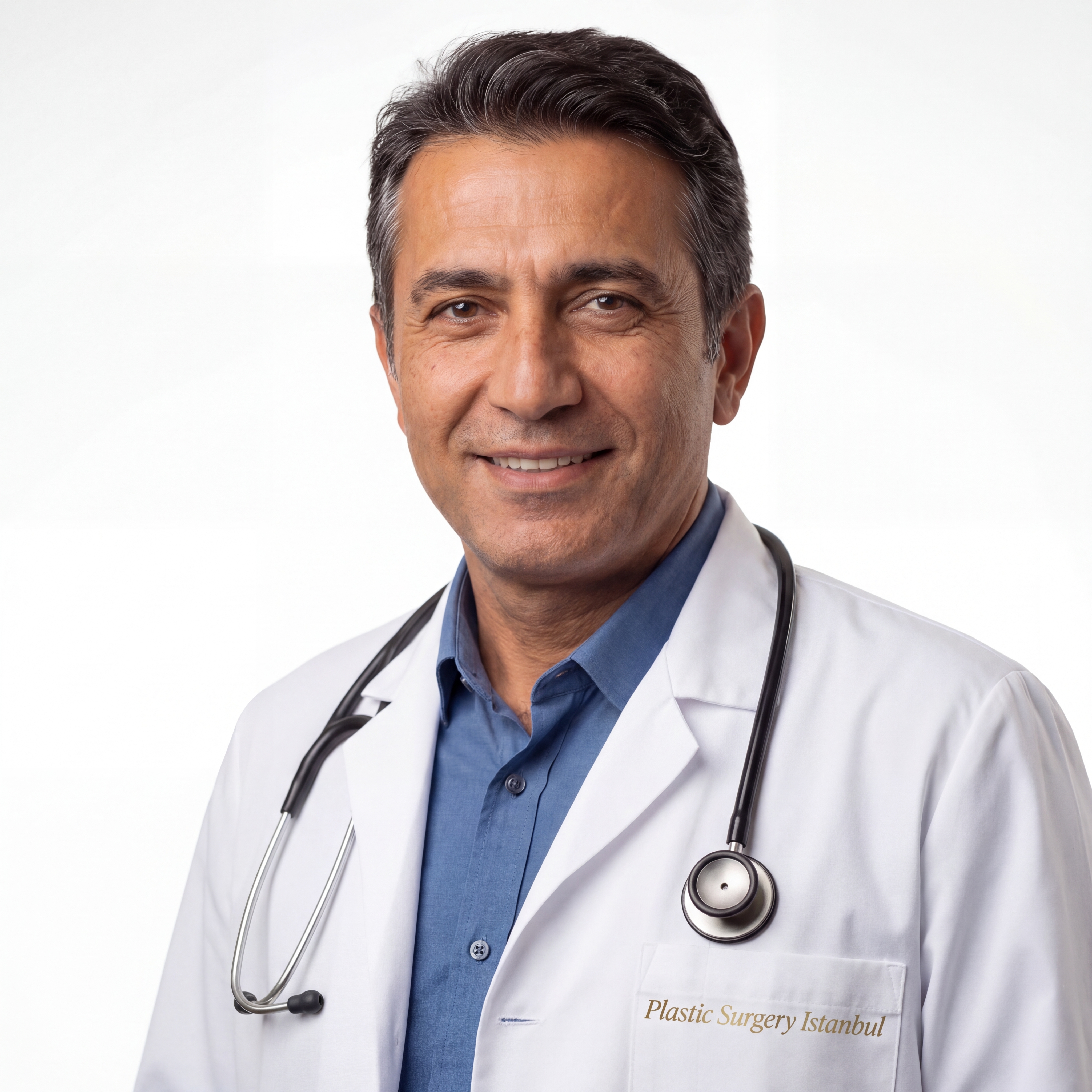
Rhinoplasty Surgeons Turkey — At a Glance
Why Our Rhinoplasty Surgeons in Turkey Win on Both Safety and Aesthetics
Our rhinoplasty surgeons in Turkey combine 10,000+ documented cases, EBOPRAS-level board certification, and Piezo ultrasonic technology inside JCI-accredited Istanbul hospitals. Led by Prof. Dr. Mehmet Kaan Uçar with dedicated aesthetic anesthesia from Dr. Barış Onur Yılmaz, the team operates a peer-reviewed, dual-attending model that consistently delivers natural, structurally stable results for U.S. patients at $3,200 – $4,800 all-inclusive.
When U.S. patients search for rhinoplasty surgeons in Turkey, they are not looking for the cheapest option — they are looking for a surgeon team that can match the technical caliber of New York or Beverly Hills while removing the $20,000 price tag. At Plastic Surgery Istanbul, our surgical model was built specifically around this expectation. Every nose is reviewed by our specialist team before the operating day, every imaging session uses the same 3D simulation software used in top U.S. clinics, and every operation is performed inside a JCI-accredited hospital with full intensive-care backup. The result is a system that doesn't just produce a beautiful nose — it produces a predictable beautiful nose, time after time, across thousands of different anatomies.
What separates our Turkish rhinoplasty surgeons from generalist plastic surgery clinics is volume-driven specialization. Prof. Dr. Mehmet Kaan Uçar performs rhinoplasty as his primary procedure — not as one of fifty things on a service menu. Twenty years of operating almost exclusively on noses gives the team an instinctive read on cartilage memory, skin-thickness behavior, and tip-support dynamics that simply cannot be taught in a textbook. This is why our internal revision rate sits well below the 10–15% global average, and why patients flying in from the United States consistently report results that are better than the quotes they received from local U.S. surgeons charging four to six times more.
Safety is engineered, not promised. Our Istanbul rhinoplasty specialists operate exclusively with Dr. Barış Onur Yılmaz, an anesthesiologist who works only on aesthetic surgery patients. He fine-tunes blood pressure to reduce intra-operative bleeding (which protects fine sutures), uses TIVA-style protocols to eliminate the post-op nausea that ruins the first 24 hours of recovery, and stays in the room for the entire procedure. This dual-attending arrangement — one specialist focused on the airway and vitals, another focused entirely on surgical artistry — is the same model used by elite cosmetic centers in Manhattan and Zurich. It is not standard practice in most Turkish clinics, and it is one of the main reasons our complication rate remains exceptionally low.
Finally, choosing the right rhinoplasty surgeon team in Turkey comes down to verifiable proof. Our gallery contains thousands of healed before-and-after cases organized by ethnicity, skin type, and surgical technique. We provide direct contact with previous U.S. patients on request. We use the same surgical materials as top European centers — PDS plates from Germany, Doyle splints from the United States, Aquaplast casts. And our pricing is fully transparent: one number, all-inclusive, no surprise hospital fees or anesthesia upcharges added at the door. This combination of clinical depth, technological investment, and operational honesty is what makes our team the destination of choice for international patients who refuse to compromise on either safety or outcome.
What Defines a True Rhinoplasty Specialist Surgeon in Turkey
A real rhinoplasty surgeon in Turkey is not measured by their website — they are measured by certifications, case volume, technology choices, and the team they operate alongside. Below are the eight markers our patients verify before flying to Istanbul, and the ones we hold ourselves accountable to every single day.
EBOPRAS & ISAPS Board Certified
Active membership in the European Board (EBOPRAS) and the International Society of Aesthetic Plastic Surgery — the two most rigorous credentialing bodies in the world.
20+ Years of Nose-Only Practice
Prof. Dr. Mehmet Kaan Uçar has dedicated two decades to nasal surgery, including academic publications and surgeon-training fellowships.
10,000+ Rhinoplasty Cases
Documented case volume that creates instinctive cartilage and tip-support judgment — the kind that cannot be learned from textbooks.
Piezo Ultrasonic Technology
Bone reshaping with ultrasonic vibrations that protect skin, vessels, and nerves — virtually eliminating bruising and cutting recovery time in half.
Dedicated Aesthetic Anesthesia
Dr. Barış Onur Yılmaz manages every airway personally — TIVA protocols, controlled hypotension, no post-op nausea.
Dual-Attending Surgical Model
Two specialists in the room at all times — one focused on artistry, one on safety. Standard at top U.S. centers, rare in Turkey.
U.S. Patient Specialization
1,800+ Americans treated. We understand U.S. aesthetic preferences, Western privacy expectations, and JCAHO-equivalent safety norms.
JCI-Accredited Hospitals Only
Surgery performed exclusively inside Joint Commission International-accredited Istanbul hospitals with full ICU and emergency backup.
The Surgical Techniques Our Rhinoplasty Surgeons Have Mastered
Our rhinoplasty surgeons in Turkey are trained across the full modern spectrum: Piezo ultrasonic for atraumatic bone work, preservation rhinoplasty for natural dorsal lines, open and closed structural for complex tip work, plus revision and ethnic specializations. The technique is matched to your anatomy — never the other way around.
Piezo Ultrasonic Rhinoplasty
Our team uses Piezo ultrasonic instruments instead of traditional hammers and chisels. Ultrasonic vibrations selectively cut bone while leaving skin, nerves, and blood vessels untouched — which is the single biggest reason our patients almost never get the dark under-eye bruising you see in older nose-job photos. Beyond the cosmetic recovery advantage, Piezo gives the surgeon microscopic control over hump removal and bridge narrowing, allowing for a level of refinement that hand instruments simply cannot match. This is why the best rhinoplasty surgeons in Turkey have already adopted it as standard.
Preservation Rhinoplasty
Modern preservation techniques (push-down and let-down) lower the entire nasal pyramid from beneath rather than resecting the dorsum from above. This keeps your natural dorsal aesthetic lines intact, eliminates the 'inverted-V' deformity that haunts older rhinoplasty results, and produces the kind of stable, organic-looking outcome that ages well. Our surgeons reserve preservation for the right candidates — typically patients with a straight, slightly high bridge — and the long-term stability data is exceptional.
Open Structural Rhinoplasty
For complex reshaping, significant tip refinement, or any case requiring cartilage grafting, our specialists choose the open structural approach. A 3-millimeter columellar incision (which heals invisibly) gives the surgeon direct visualization of the entire nasal framework. This is the only way to place spreader grafts, septal extension grafts, and lateral crural strut grafts with millimeter-level precision. Open structural is the technique of choice for U.S. patients who want a permanent, supported result that won't collapse over time.
Closed (Endonasal) Rhinoplasty
When the case allows it, our surgeons offer closed rhinoplasty — all incisions hidden inside the nostrils, no external scar whatsoever. This requires the kind of three-dimensional spatial intuition that only comes from a 10,000-case career, because the surgeon is operating without direct visual access to the framework. The reward is faster tip de-swelling and an absolutely scarless external result. Not every nose is a candidate, and our team will tell you honestly which approach suits your anatomy.
Revision Rhinoplasty
Correcting a previous surgery is the hardest test for any nasal surgeon. Our revision rhinoplasty surgeons in Turkey routinely rebuild noses that have been over-resected elsewhere, using auricular (ear) or costal (rib) cartilage to restore structure. Revision cases require deep understanding of scar tissue planes, compromised blood supply, and tip-support reconstruction. We accept revision patients other clinics decline — and we provide a completely separate, longer consultation process to make sure expectations and surgical reality are perfectly aligned before the operating day.
Ethnic Rhinoplasty
Our surgeons specialize in ethnic rhinoplasty for Middle Eastern, African, Asian, and Hispanic patients — preserving the cultural identity of your face while refining the features that bother you. Thicker skin requires more aggressive structural support; flatter bridges need augmentation grafting; bulbous tips need careful interdomal suturing. We do not 'Westernize' noses. We refine them, in proportion to your ethnic features, and the result is a nose that looks like it was always meant to be yours.
Our Rhinoplasty Surgeons vs. Top U.S. Cities
Compared to the United States, the difference is not 'Turkey is cheaper' — it is specialization volume meets price transparency. A top New York surgeon performs 50–100 rhinoplasties per year. Our team performs that many in a single month. That volume gap, combined with all-inclusive pricing, is why U.S. patients increasingly fly to Istanbul.
The math is unforgiving for U.S. clinics. A patient flying from New York to Istanbul saves $11,000–$18,000 *after* paying for business-class flights, a five-star hotel, and a week of recovery in Sultanahmet. And the work is performed by surgeons who have personally operated on more noses in the last twelve months than most American board-certified surgeons will operate on in their entire career.
How to Vet Rhinoplasty Surgeons in Turkey (7 Non-Negotiables)
Choosing a rhinoplasty surgeon in Turkey without a checklist is dangerous. The market has world-class surgeons and dangerous beginners side-by-side. Below are the seven criteria our patients use — the same criteria a U.S. medical board would expect — to filter the noise.
Verifiable Board Certification
Demand to see active membership in ISAPS or EBOPRAS, not just 'Turkish Society of...' affiliations. Our lead surgeon is a current EBOPRAS diplomate — verifiable on the EBOPRAS public registry. Anything less and you have no recourse if something goes wrong.
Rhinoplasty-Specific Case Volume
A general plastic surgeon doing 30 noses a year is not a nose specialist. You want a surgeon performing at least 400–500 rhinoplasties annually, in a clinic that publishes (or will share on request) documented before-and-after galleries organized by technique. Our 10,000-case archive is open to consultation patients in full.
Piezo Ultrasonic as Standard
If a surgeon still uses traditional hammers and chisels in 2026, they have not invested in their craft. Piezo is the modern standard for any serious rhinoplasty practice — it protects soft tissue, eliminates bruising, and produces smoother bridge lines. Our team uses Piezo on every primary case where bone work is involved.
Dedicated Aesthetic Anesthesiologist
Most clinics use whichever anesthesiologist is on the hospital rota that morning. We don't. Dr. Barış Onur Yılmaz is part of our permanent team — he manages every single rhinoplasty himself, with TIVA protocols specifically tuned for cosmetic patients (low bleeding, no post-op nausea, fast wake-up).
JCI-Accredited Hospital Operating Rooms
Never consent to surgery inside a 'medical office' or unaccredited day-surgery center. Real rhinoplasty belongs in a JCI-accredited hospital with ICU backup, sterile ventilation, and emergency teams on-site. Every operation we perform meets this bar — no exceptions, no shortcuts.
Honest 3D Imaging — No Photoshopped Promises
Beware surgeons who show you Photoshopped 'after' pictures. We use Vectra-style 3D imaging to simulate your realistic post-op result during consultation. If a surgeon promises something the imaging doesn't support, walk away. Our team will sometimes tell U.S. patients the result they want is anatomically impossible — that honesty is the marker of a real specialist.
Long-Term Aftercare Infrastructure
Rhinoplasty heals over 12–18 months. The surgeon you choose must offer scheduled video follow-ups at 1, 3, 6, and 12 months, with a dedicated coordinator who answers your messages within 24 hours. Anything less and you are paying for a surgery, not a result. Our aftercare program is built into every package, automatically.
Working With Our Rhinoplasty Surgeons — The 7-Day Istanbul Process
Working with our rhinoplasty surgeons in Turkey takes a single 7-day trip to Istanbul: free virtual consultation → 3D simulation → arrival and in-person mapping → Piezo surgery in a JCI hospital → 5 days of monitored hotel recovery → cast removal and clearance to fly. Every logistical detail (transfers, hotel, meds, nursing) is handled by us.
Your journey begins long before you board the plane. After your first message, our medical coordinators collect frontal, profile, three-quarter, and base photos of your nose, plus a written brief on what bothers you and what you'd like to change. This package is personally reviewed by Prof. Dr. Mehmet Kaan Uçar, not by a sales agent. Within 48 hours you receive a written surgical plan: the recommended technique (Piezo, preservation, open, closed, or revision), an honest assessment of what is and is not anatomically achievable, and an exact all-inclusive quote with no hidden lines. Only after you've reviewed this plan and had a video call with the surgeon do we proceed to booking.
On day one in Istanbul, our VIP transport meets you at the airport and brings you to your five-star hotel. Day two is your in-person consultation and 3D simulation — this is where we finalize every millimeter of the surgical plan and you see a realistic preview of your result. Day three is surgery: 2.5–4 hours in a JCI-accredited operating theater, with our dual-attending team. You spend one night under nursing observation, then transfer back to the hotel where our nurses visit daily for swelling checks, splint care, and medication management. On day six or seven we remove the external cast and internal silicone splints, perform a final clearance exam, and you fly home with a complete written aftercare protocol — plus scheduled video follow-ups at the 1, 3, 6, and 12-month marks.
Why U.S. Patients Trust Our Rhinoplasty Surgeons in Turkey
Trust is not a marketing line — it is built from infrastructure. Our rhinoplasty surgeon team operates inside a system designed specifically for international patients: U.S.-based patient liaisons available during American business hours, transparent all-inclusive pricing fixed in U.S. dollars, JCI-accredited hospital partners, and a written 12-month aftercare commitment that follows you home to the United States. Every promise we make is documented in your patient agreement before you book.
We are also transparent about our limitations. Our surgeons will sometimes decline a case — when the requested change is anatomically unrealistic, when a patient's expectations don't align with surgical reality, or when a revision is too premature to be safely performed. This selectivity is exactly why our long-term outcome rate is so high. The best rhinoplasty surgeons in Turkey are not the ones who say yes to everyone; they are the ones who say no when the answer should be no.
Above all, you are choosing a center of excellence, not a tourist clinic. Every patient receives the same standard of care — whether you are flying in from Manhattan, London, or Sydney. The same surgeon, the same anesthesiologist, the same hospital, the same protocols. That consistency is what allows us to publish 10,000+ documented results and invite every prospective patient to scrutinize them in full.
Transparent All-Inclusive Pricing
One USD number covers surgery, hospital, anesthesia, hotel, transfers, medications, splints, and 12-month follow-up. No surprises at the door.
U.S.-Hours Patient Support
Dedicated American-time-zone coordinators respond within hours, not days — before, during, and after your trip to Istanbul.
Peer-Reviewed Surgical Planning
Every case is reviewed by the full specialist team before the operating day. Two sets of expert eyes catch what one might miss.
JCI-Accredited Hospital Standard
Every operation performed in a Joint Commission International-accredited Istanbul hospital with full ICU, emergency backup, and aesthetic anesthesia.
Continue Your Research
Frequently Asked Questions: Rhinoplasty Surgeons in Turkey
Talk To Our Rhinoplasty Surgeons in Turkey — Free 3D Consultation
Send a few photos of your nose and get a personal, written assessment from Prof. Dr. Mehmet Kaan Uçar within 48 hours. No sales pressure, no obligations — just a real surgeon's opinion on what's achievable for you.
- Personal review by the lead rhinoplasty surgeon — not a sales agent
- Honest written surgical plan + 3D simulation before you commit
- Transparent all-inclusive USD pricing, locked in writing
- JCI-accredited hospital, EBOPRAS-certified team, 12-month aftercare
Facial Surgery
Related Procedures
Explore other facial surgery options available at our Istanbul clinic.